
Social Security Series (Part 2): Benefit Calculations & Working in Retirement
By Logan Sanders, CFP® | Retirement Planning | Retiree Income Planning
Social Security is often the largest guaranteed asset in a retiree’s portfolio, yet it is also one of the most misunderstood.
Over our 5-part series, we’re covering a wide range of topics to help you navigate the system. Everything from claiming ages and benefit calculations, to the 'Tax Torpedo,' spousal rules, and the potential future solvency of the program.
Our goal is to help you gain a better understanding of Social Security and the critical role it can play in your overarching retirement plan.
Below is Part 2 of the series. (Note: If you are ready to explore the entire comprehensive resource right now, you can access it using the form below)
Your Social Security benefit isn't just an arbitrary estimate. It’s determined by a precise formula that considers your 35-year earnings record, claiming timing, and strict administrative rules regarding outside income. Here, we examine how the government calculates your baseline check and what happens if you continue working or receive a pension.
How does the government calculate my monthly check?
The Quick Answer: The government calculates your baseline monthly benefit using a progressive formula based on your 35 highest-earning years in the workforce. If you don't have 35 years of documented earnings, the missing years are factored into your calculation as zeros, which permanently drags down your average.
To calculate a benefit based on your own earnings record, the Social Security Administration uses a formula that looks across your entire lifetime. However, the calculation only considers income that you and your employer paid FICA taxes on.
- Examples of What Counts: Earned income like traditional W-2 wages or active self-employment net earnings (from a sole proprietorship for example).
- Examples of What Does Not Count: Investment income, dividends, interest, and the pass-through portion of business income from a partnership or S-corporation.
The Annual Cap: If you are a high earner, not every dollar of your salary counts toward your future benefit. Each year, the government sets a wage cap ($184,500 for 2026) above which the Social Security portion of FICA taxes is no longer applied. Any income earned above this cap is excluded from your benefit calculations.
Checking Your Earnings Record: You can review your full earnings history anytime by creating a free account on ssa.gov. It’s important to review this record periodically to ensure all years you paid Social Security taxes were recorded accurately, as correcting missing or misreported income can become harder the longer you wait.
The Actual Step-by-Step Calculation
Social Security provides benefit estimates on your statement and offers free calculators to test different scenarios. That said, understanding how the math works can be helpful in certain planning situations. If you’re interested, check out the steps below. If not, feel free to skip ahead.
- Step 1: Wage Indexing: The government reviews your lifetime earnings history up to each year's maximum taxable wage limit. To account for inflation and national wage changes over time, they multiply your historical pay by an indexing factor to bring your past earnings up to modern dollar equivalents.
- Step 2: The 35-Year Average: They pull your top 35 highest-indexed earning years, add them together, and divide the total by 420 (the number of months in 35 years). This yields your Average Indexed Monthly Earnings (AIME).
- Step 3: The "Bend Points" Formula: Finally, they apply a progressive formula to your Average Indexed Monthly Earnings (AIME), taking 90% of your first tier of earnings, 32% of your middle tier, and only 15% of your highest tier (as shown in the diagram below). Because of this formula, Social Security is structurally designed to replace a higher portion of lower income tiers, providing diminishing returns for higher levels of income up to the annual wage cap.
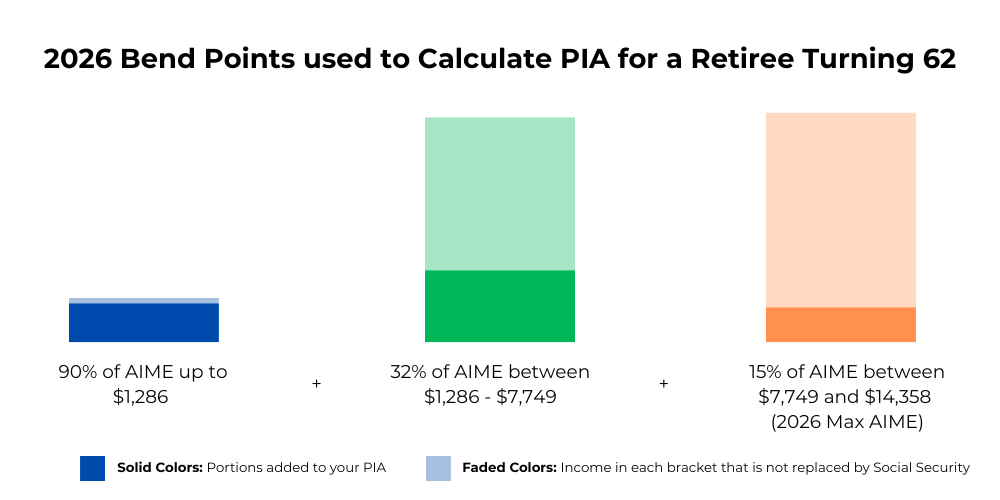
The Result: The final combined number represents your Primary Insurance Amount (PIA), which is the exact monthly check you are entitled to receive if you claim precisely at your Full Retirement Age.
Adjustments Based on Timing: If you claim either before or after your Full Retirement Age, your actual benefit will differ from your PIA (though your PIA remains the baseline anchor for the calculation):
- Permanent Reductions for Claiming Early: Your benefit is reduced for every single month you claim prior to your FRA, it isn't an annual all-or-nothing cliff. For someone with an FRA of 67, the reduction is 6.67% per year for the first 3 years prior to FRA, and 5% per year for years beyond that:
- Age 62 (60 months early): 30.0% reduction (you receive 70.0% of your PIA)
- Age 64 (36 months early): 20.0% reduction (you receive 80.0% of your PIA)
- Age 65 (24 months early): 13.3% reduction (you receive 86.7% of your PIA)
- Age 66 (12 months early): 6.7% reduction (you receive 93.3% of your PIA)
- Permanent Credits for Claiming After FRA: For every year you delay claiming past your FRA up to age 70, your benefit earns Delayed Retirement Credits of 8% per year (roughly 0.67% per month). Waiting until age 70 results in a 24% permanent boost above your baseline PIA.
6-Month Retroactive Lump-Sum Option after FRA
If you apply for Social Security after reaching your Full Retirement Age (e.g., at age 68 or 69), the Social Security representative processing your application may offer you a single lump-sum check for up to 6 months of back pay.
While receiving a sudden $15,000–$25,000 cash payout sounds enticing, it comes with important trade-offs:
- Permanent Check Reduction: Accepting the lump sum retroactively rolls back your official claim date by 6 months. Doing so permanently wipes out 6 months’ worth of built-up Delayed Retirement Credits, resulting in a ~4% permanent reduction in your monthly check for the rest of your life (while also permanently lowering the future survivor benefit for your spouse).
- Tax & IRMAA Friction: Dumping 6 months of back pay into a single calendar year can unexpectedly push your Combined Income into higher federal tax brackets or trigger a higher Medicare IRMAA tier, significantly blunting the net value of the payout.
Having this lump-sum option available provides valuable flexibility, especially if you face sudden health changes or need immediate liquidity, but it should only be accepted after carefully weighing the short-term cash boost against the long-term impact on your lifetime income plan.
Quick Note on Your Actual Check Size:
If you are enrolled in Medicare, your monthly Part B premiums (and any IRMAA surcharges based on prior income) will typically be automatically deducted directly from your Social Security check before deposit, meaning your bank deposit will reflect your net benefit (after both Medicare deductions and any voluntary tax withholding) rather than the gross amount on your statement.
The Planning Perspective
The 35-year rule introduces a critical planning consideration for individuals who want to retire early at age 55 or 60. If you exit the corporate world early, you stop paying into the Social Security system. If you only worked for 25 or 30 years total before retiring, the formula will automatically fill in those remaining 5 to 10 missing years with $0 earnings entries. Stacking multiple zeros into your 35-year average can dilute your lifetime baseline check.
Crucially, the standard statements and benefit estimates provided by Social Security assume that you will continue to work at your current income level up until the exact day you collect your check. If you retire early, the difference between what your standard SSA statement predicts and your actual real-world check can be substantial. When we build an early retirement exit strategy, we model exactly how these $0 years will impact your future income stream, allowing you to decide if executing a few years of consulting or part-time work is mathematically worth it to replace those zeros.
Case Study: The Potential Early Retiree Benefit Estimate Overstatement
The Hypothetical Scenario:
Consider Mark, a 55-year-old corporate executive (hypothetical example for illustrative purposes) planning to exit the workforce early. He entered the workforce at age 22, building a 33-year work history that includes 8 lower-earning entry-level years in his 20s and 25 years of high executive earnings at or near the Social Security taxable wage cap ($184,500 in 2026). When Mark logs into his ssa.gov account, his official Social Security statement estimates his baseline check at Full Retirement Age (age 67) will be approximately $4,200 per month.
The Potential Hidden Trap:
Social Security calculates benefits using a 35-year average of indexed earnings. Because Mark is retiring at age 55, he stops paying FICA taxes completely. The government’s calculation formula will fill his remaining 35-year record using his 8 early low-earning years plus 2 years of $0 earnings.
It’s important to know that standard statements on ssa.gov assume you will continue working at your current salary until the day you claim. Mark’s ~$4,200 estimate assumes he works another 12 years at maximum salary until age 67.
The Real-World Impact:
When we factor Mark’s actual 33-year career history and early retirement into the official 2026 calculation formula:
- Social Security Statement Estimate (Assumes 35 near-max earning years): ~$4,200 / month at FRA
- Mark's Actual Benefit (Reflecting 8 low-earning years + 2 zero-earning years): ~$3,750 / month at FRA
- The Discrepancy: -$450 per month (-$5,400 per year)
Over a 30-year retirement, relying on his unadjusted statement estimate could leave Mark short by ~$162,000 in lifetime income (before factoring in cumulative cost-of-living adjustments).
The Planning Takeaway:
Early retirement strategies require custom modeling. If you’re retiring prior to your planned claiming age, do not solely rely on raw statement estimates from ssa.gov. Knowing how your future earnings (or lack thereof) impact your true Social Security benefit allows you to build your long-term retirement plan more accurately. For some, the difference is minimal, and for others, it can have a real impact.
Can I work and collect Social Security at the same time?
The Quick Answer: Yes, you can continue to work while collecting your benefits. However, if you claim benefits before reaching your Full Retirement Age (FRA), your monthly checks may be temporarily reduced or paused due to the government's strict Earnings Test.
The Earnings Test limits apply exclusively to your earned income (like W-2 wages or net self-employment income). Passive income streams, such as dividends, interest, and the pass-through portions of S-corporation or partnership distributions, do not impact your test.
How the reduction applies if you’re collecting benefits while still working depends on your proximity to your Full Retirement Age and level of earnings from work:
- In the Calendar Years Before You Reach FRA: For 2026, the annual earnings limit is $24,480. If you are under your FRA for the entire calendar year, the government will reduce your benefit by $1 for every $2 you earn above that threshold.
Example: If you earn $34,480 in 2026 ($10,000 over the limit), your benefit is reduced by $5,000 ($10,000 / 2). If your regular benefit is $2,000 a month, the government satisfies this reduction by withholding your entire check for January, February, and March ($6,000 total). In April, your regular $2,000 monthly checks resume, and the over-withheld $1,000 is refunded to you the following year. - In the Calendar Year You Reach Your FRA: The rules become much more generous in the year you’ll reach your FRA. For 2026, the earnings limit jumps to $65,160, and the reduction drops to $1 for every $3 earned above the threshold.
Example: If you collect benefits for the full year but don’t turn 67 until September and earn $80,160 from January through August ($15,000 over the limit of $65,160), your benefit is reduced by $5,000. Again, if your check is $2,000, they will withhold your full payments for the first three months of the year, resume regular payments in April, and square up the remaining $1,000 refund the following year. - Once You Reach FRA: Starting the exact month you reach your Full Retirement Age, the earnings test vanishes completely. You can earn an unlimited amount of income with zero benefit reductions.
Do You Permanently Lose the Withheld Benefits?
No. The money withheld during the working years is not a permanent penalty. Once you cross your Full Retirement Age, the Social Security Administration automatically recalculates your baseline benefit. They adjust your lifetime reduction factor upward, essentially acting as if you chose to claim your benefits later than you actually did. For example, if the earnings test caused you to lose 12 months of checks, your new FRA baseline will be permanently increased as if you began collecting benefits 12 months later than you actually did.
What If You Retire Mid-Year?
If you retire in the middle of a calendar year, your year-to-date earnings might already exceed the annual threshold. To prevent you from being penalized immediately upon retirement, the government offers a special grace period during your first year of claiming benefits in which they’ll look at your earnings on a month-by-month basis rather than annually.
Under this rule, the government ignores your year-to-date income and instead looks strictly at your month-by-month earnings after you claim. In 2026, as long as your monthly earnings fall below $2,040 (if you’re under FRA all year) or $5,430 (in the months prior to FRA during your transition year), you are considered "retired" for that specific month and will receive your full check regardless of what you earned earlier in the year.
Keeping the Government Informed
The system relies on proactive reporting. You must notify the Social Security Administration of your estimated earnings if you plan to work while claiming early. If your sole proprietorship income or earnings from employment shift mid-year, updating your estimates can help to avoid the stress of an unexpected overpayment bill or sudden benefit adjustments down the line.
The Planning Perspective
Two surprises for retirees regarding the earnings test come down to timing and liquidity. First, the Social Security Administration evaluates your earnings based on when the money was actually earned, not when the check cleared. If you transition into retirement but receive a large performance bonus, corporate payout, or insurance commission, that money may be exempt from the earnings test if it was for work performed prior to retirement, provided your employer documents it correctly.
Second, you must be prepared for cash flow friction at the beginning of the year. Because the government pauses your entire monthly check at the very beginning of the calendar year until the overage is fully collected, you don't get a gentle, smoothed-out reduction throughout the year. You get consecutive months of $0 income from Social Security right out of the gate. When building a transition timeline, it’s important to ensure you have a dedicated cash-flow bridge in place to seamlessly cover those front-loaded zero months.
Will receiving a pension reduce my Social Security benefit?
The Quick Answer: For traditional private corporate pensions, no, not at all. If you paid Social Security (FICA) taxes on your income while earning your pension, receiving that pension will have zero impact on your Social Security check.
If you earned a pension from a government or public sector job where you did not pay Social Security taxes (a "non-covered pension"), there were previously rules in place that could reduce your Social Security benefit, but those rules recently changed in a major way.
Historically, two strict provisions, the Windfall Elimination Provision (WEP) and the Government Pension Offset (GPO), severely reduced or even completely wiped-out Social Security benefits for workers with non-covered pensions. However, with the passage of the Social Security Fairness Act, these restrictions were repealed and no longer apply to current or future benefits.
Here is how pension income interacts with Social Security today under the new rules:
- Your Own Work Record: While the old WEP penalty no longer artificially slashes your benefit formula, your baseline check is still calculated using your top 35 years of Social Security-covered earnings. If you spent most of your career working in a non-covered public position, those years will show up as $0 in your Social Security earnings record, naturally resulting in a smaller (or zero) personal benefit check.
- Spousal & Survivor Benefits: This is where the repeal of GPO potentially creates the biggest opportunity. Under the old rules, receiving a government pension would often reduce or completely eliminate any spousal or survivor benefit you were entitled to claim on your spouse’s work record. Today, that offset is gone. You can now be eligible to claim a full spousal or survivor benefit based on your spouse's earnings history, even if you spent your career paying into a separate non-covered pension system.
Action Item for Public Employees & Surviving Spouses:
If you previously refrained from filing for spousal or survivor benefits because the old GPO rules would have reduced your payout to $0, or if you believe your current benefits haven't been properly adjusted following the repeal, it is well worth scheduling an appointment with your local Social Security office to review your file.
The Planning Perspective
The repeal of WEP and GPO is a game-changer for public sector workers, teachers, first responders, and their families. If your retirement plan previously assumed you wouldn't receive Social Security due to a public pension, your guaranteed income floor may now be thousands of dollars per year higher than originally modeled.
However, adding a Social Security check on top of a fixed monthly pension creates a potential change to your tax situation to be aware of. Because both pension income and Social Security count toward your total taxable baseline, combining them can push you into higher federal tax brackets and trigger the "Tax Torpedo" or Medicare IRMAA surcharges.
The strategic play isn't just collecting your new benefit; it's coordinating when to claim Social Security alongside your pension income and how this change impacts your overall retirement plan.
Ready to See How Social Security Fits Into Your Complete Retirement Plan?
Social Security claiming decisions shouldn't be made in a vacuum. How and when you claim can impact your lifetime income plan, portfolio drawdown strategy, multi-year tax planning, potential Roth conversion windows, and more.
Please Note: Sanders Retirement Planning is a comprehensive financial planning and investment management firm. We do not offer standalone Social Security filing services or single-topic phone consultations. We work with pre-retirees and retirees looking for a fully integrated, multi-year retirement income and wealth management strategy.
Important Disclosure: This guide is provided for informational and educational purposes only and does not constitute financial, tax, or legal advice. Every individual's situation is unique. Please consult your financial advisor, CPA, and/or estate attorney before implementing any strategy discussed here. All examples given are hypothetical in nature and are provided for illustrative purposes only, do not represent the actual results of any specific client, and are not guarantees of future investment performance or tax outcomes. Actual plan rules, employer matching structures, and individual tax profiles will vary.