
Social Security Series (Part 1): The Basics & Timing Rules
By Logan Sanders, CFP® | Retirement Planning | Retiree Income Planning
Social Security is often the largest guaranteed asset in a retiree’s portfolio, yet it is also one of the most misunderstood.
Over the next five posts, we’ll be covering a wide range of topics to help you navigate the system. Everything from claiming ages and benefit calculations, to the 'Tax Torpedo,' spousal rules, and the potential future solvency of the program.
Our goal is to help you gain a better understanding of Social Security and the critical role it can play in your overarching retirement plan.
Below is Part 1 of the series. (Note: If you are ready to explore the entire comprehensive resource right now, you can access it using the form below).
Before evaluating potentially complex claiming strategies, you need a clear baseline understanding of your Full Retirement Age and how claiming early or late can permanently adjust your check. In this section, we cover the core timeline rules that serve as the foundation of your Social Security strategy.
What is Full Retirement Age (FRA)?
The simplest way to think about your Full Retirement Age or “FRA” is that it’s the age at which you can begin collecting your full, unadjusted Social Security benefit.
Your actual FRA depends on when you were born.
- For anyone born prior to 1959: you’ve already reached your FRA.
- For those born in 1959: your FRA is age 66 and 10 months.
- For anyone born in 1960 and beyond: your current FRA is age 67 (though this is subject to change).
While some people treat their FRA like the age they are 'supposed' to stop working or claim benefits, it’s really just an age used to calculate different figures or potential penalties.
What is the earliest age I can start taking Social Security?
The Quick Answer: You can legally begin collecting your personal retirement or spousal benefits as early as age 62. If you are a surviving spouse, you may become eligible to claim survivor benefits even earlier, starting at age 60.
To collect a benefit based on either your own earnings record or your living spouse's earnings record, you must be at least age 62. However, it's important to know that for every month that you begin collecting your benefit prior to your Full Retirement Age (age 67 for those born in 1960 and beyond), your starting benefit will be permanently reduced…more on the exact math of that below.
The timeline shifts if you are facing the loss of a spouse:
- Surviving Spouses: May be eligible to collect a survivor benefit based on their deceased spouse’s earnings record starting at age 60 (or age 50 if disabled).
- Caring for Children: A surviving spouse can potentially collect survivor benefits at any age if they are currently caring for the deceased worker's child who is under age 16 or disabled.
The Planning Perspective
Think of age 62 and age 60 as the opening of your Social Security claiming window, not an instruction manual to file immediately. The fact that you can access these funds early is a valuable insurance policy if life forces your hand due to job loss or health changes. But because the government reduces your monthly check for every month you claim prior to your FRA, hitting these birthdays means it’s time to run a comprehensive retirement model, not blindly submit an application.
Should I take Social Security at 62 or wait until 70?
The Quick Answer: Ultimately, the “right” answer to this question will only be known in hindsight once your actual life expectancy is determined. Because no one knows that date, the goal is to make reasonable, strategic decisions based on the variables you can control.
Your Social Security benefit strategy should be coordinated with your other streams of recurring income and potential distributions from your savings and investments. Because everything must fit together as one cohesive plan, determining a precise strategy for your household is beyond the scope of a single post. We walk through how to integrate all of these moving parts into a unified strategy in our companion Retirement Modeling Guide.
However, here are the core factors you should weigh when evaluating your options:
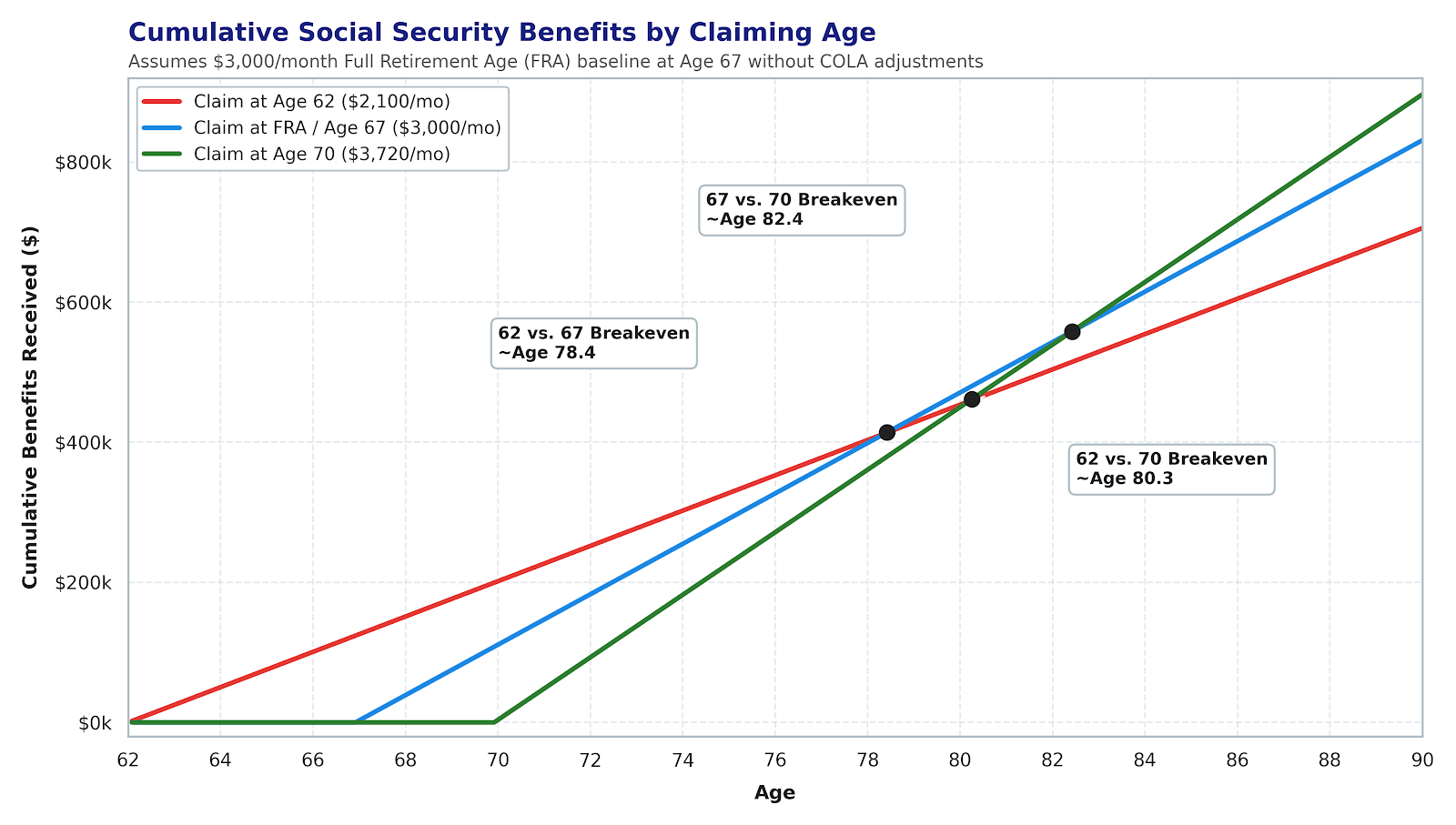
- How much can the numbers differ? For someone born in 1960 and beyond, collecting at age 70 will result in a monthly check that is roughly 77% higher than collecting their benefit at age 62. For example, someone with a Full Retirement Age benefit of $3,000 per month would receive only $2,100 if they begin collecting at age 62, compared to $3,720 if they wait until age 70. This difference in guaranteed income can be substantial for a retiree trying to make ends meet and provide real long-term security.
- Can you afford to wait? While securing a larger benefit by waiting until 70 may sound ideal, you must have alternative income sources to fund your living expenses between age 62 and 70 to make it work. This requires either working longer, drawing from other income sources, or drawing down on other liquid investments, and these paths aren’t necessarily viable options for every household.
- Will a spouse depend on your survivor benefit? In a married couple, the amount of the larger of the two individual Social Security benefits typically serves as the surviving spouse’s benefit. This often makes a strategy to delay the higher earner’s benefit worth considering, as it allows this baseline to grow for the longevity of both lives, protecting whichever spouse happens to live the longest.
- Is your spouse waiting for you to "open the door" for spousal benefits? Under current Social Security rules, your spouse cannot claim a spousal benefit based on your work history until you officially file for your own retirement benefit. If your spouse has a smaller earnings record and is eligible for a spousal top-off, holding out until age 70 forces the spousal portion of their benefit to remain at $0 in the interim. In some households, filing at Full Retirement Age (or earlier) to "open the door" for immediate combined cash flow can potentially outweigh the benefit of waiting until 70 for your individual check to max out.
- Are you still working? If you choose to earn an income prior to reaching your Full Retirement Age, the Social Security benefit you actually receive may be temporarily reduced due to the government's strict earnings test limitations.
- What is your mix of recurring income vs. liquid assets? Social Security is an incredible asset because it provides a recurring, inflation-adjusted income stream. However, if your retirement lifestyle is already well funded by other recurring streams (like a corporate pension) but your liquid investment portfolios are relatively light, it may make strategic sense to collect Social Security sooner to preserve or even grow your liquid net worth.
- Are you claiming early out of fear of insolvency? It is common to want to rush and pull the lever at age 62 because headlines constantly warn that the system is going "bankrupt." The reality is far more nuanced. According to the 2026 Social Security Trustees Report, if Congress takes no action before the retirement trust fund is depleted in late 2032, incoming payroll taxes will still cover roughly 78% of scheduled retirement benefits. While Congress may step in to fix the shortfall before then, it’s possible that a legislative patch will be progressive, meaning they could protect lower-income beneficiaries while reducing benefits or altering inflation adjustments for higher-earning households. Rushing to lock in a guaranteed, permanent 30% reduction at age 62 may not actually shield an affluent household from future legislative changes or means-testing. While Social Security strategies involve the consideration of many unknown variables, future legislative changes may be among the hardest to predict. Your timeline should be dictated by your own unique circumstances, including your lifetime tax, income, and asset architecture.
- How does your current health and family history impact things? If both your family history and current health point toward a shorter-than-average life expectancy, it may be tempting to start benefits sooner. Ultimately, this could be the right answer for you, but it’s also important to consider that people often outlive their life expectancy. With that in mind, we suggest going back to the core questions: Do you have enough other income and assets to continue supporting the older version of you if you do happen to live longer than expected? Will anyone else be counting on your benefit as their own survivor benefit once you pass?
What about the "Break-Even" age?
If you compare claiming at 62 versus waiting until age 70 on a simple, nominal cash-flow basis (without applying a discount rate), the cumulative break-even point arrives right around age 80 to 81. If you pass away before age 80, claiming at 62 technically pays out more total cumulative dollars. If you live past age 81, waiting until 70 can generate more lifetime wealth.
Why Break-Even Math Misses the Point:
Viewing Social Security through a strict break-even lens assumes the goal is to beat the system and get back what you paid in. In reality, Social Security is longevity insurance. Passing away early is a tragic outcome, but your investment portfolio likely won't run out of money in that scenario.
Perhaps the greater financial risk in retirement is living well into your 90s and exhausting your liquid assets. Delaying your benefit isn't "gambling on your health", it should be a strategic decision designed to protect the "older you" with a maximized, recurring, inflation-adjusted stream of income when you need it most.
Assumptions, Opportunity Costs & Risk Realities
This break-even analysis reflects standard cash-flow comparisons. In a real-world retirement plan, several interrelated variables impact how this decision plays out for your household:
- Market Outperformance vs. Risk Profiles: Claiming at age 62 and investing the monthly checks into the stock market absolutely could outperform waiting until age 70 if equity markets perform well. However, doing so trades a guaranteed increase to a stream of income for potential market volatility and sequence-of-returns risk. If you are looking for a risk-matched benchmark, fixed-income instruments or Treasury Inflation-Protected Securities (TIPS) may offer a closer comparison than stocks, though we’re not aware of any private financial product that perfectly replicates Social Security's lifetime inflation-adjusted structure.
- Portfolio Drawdown (Opportunity Cost): If delaying Social Security until age 70 forces you to pull extra funds from your investment portfolio to cover living expenses between ages 62 and 70, you forgo whatever compound growth those portfolio assets might have generated during those gap years.
- How COLA Affects the Math: Because annual Cost-of-Living Adjustments are percentage-based, a 3% COLA adds a larger raw dollar increase to a higher baseline check. While this causes the raw cash gap to widen in high-inflation years, inflation also erodes purchasing power across the board. In real purchasing power terms, COLA protects both options equally, leaving your true real-world breakeven timeline the same regardless of the inflation rate.
Because these variables depend heavily on your asset allocation, actual market returns, tax profile, and personal health, a break-even chart serves as a helpful baseline—not a standalone decision tool.
The Planning Perspective
Think of the choice between 62 and 70 not as a game of trying to beat the system, but as a risk-management decision. Delaying your benefit is essentially buying a recurring, inflation-protected insurance policy against outliving your wealth. It can be among the highest-yielding 'investments' available to a retiree. But if health challenges are present, or if forcing yourself to wait means you have to cannibalize your investment portfolio during a severe market downturn, pulling the lever early can act as a critical shield for the rest of your wealth.
Ready to See How Social Security Fits Into Your Complete Retirement Plan?
Social Security claiming decisions shouldn't be made in a vacuum. How and when you claim can impact your lifetime income plan, portfolio drawdown strategy, multi-year tax planning, potential Roth conversion windows, and more.
Please Note: Sanders Retirement Planning is a comprehensive financial planning and investment management firm. We do not offer standalone Social Security filing services or single-topic phone consultations. We work with pre-retirees and retirees looking for a fully integrated, multi-year retirement income and wealth management strategy.
This guide is provided for informational and educational purposes only and does not constitute financial, tax, or legal advice. Every individual's situation is unique. Please consult your financial advisor, CPA, and/or estate attorney before implementing any strategy discussed here. All examples given are hypothetical in nature and are provided for illustrative purposes only, do not represent the actual results of any specific client, and are not guarantees of future investment performance or tax outcomes. Actual plan rules, employer matching structures, and individual tax profiles will vary.