
Social Security Series (Part 3): Taxes & The "Tax Torpedo"
By Logan Sanders, CFP® | Retirement Planning | Retiree Income Planning
Social Security is often the largest guaranteed asset in a retiree’s portfolio, yet it is also one of the most misunderstood.
Over our 5-part series, we’re covering a wide range of topics to help you navigate the system. Everything from claiming ages and benefit calculations, to the 'Tax Torpedo,' spousal rules, and the potential future solvency of the program.
Our goal is to help you gain a better understanding of Social Security and the critical role it can play in your overarching retirement plan.
Below is Part 3 of the series, which is focused on how your Social Security benefit can be taxed. (Note: If you are ready to explore the entire comprehensive resource right now, you can find it here: Read our Ultimate Social Security Guide).
Social Security income doesn't exist in a vacuum; drawing your benefit can trigger unexpected tax spikes across your IRAs, 401(k)s, and overall portfolio. This section breaks down how benefits are taxed under federal law and how to navigate the potential phased-in tax trap known as the "Tax Torpedo."
Will my Social Security benefits be taxed?
The Quick Answer: Potentially. Some retirees are surprised to hear this after seeing news headlines about new laws introducing "no tax on Social Security." While the One Big Beautiful Bill Act (OBBBA) introduced an expanded tax deduction for many seniors (see our breakdown video here), the underlying tax rules for Social Security remain in place. Under federal law, anywhere from 0% to 85% of the Social Security income you receive can be included as taxable income on your federal return. The exact percentage depends on your total "Combined Income." Importantly, the taxable portion of your benefit is completely different from the tax rate that actually applies to it.
At the state level, rules vary widely. Many states, including Nebraska, Iowa, and California, do not tax Social Security benefits at all, providing an extra layer of potential tax efficiency depending on where you live in retirement.
How the Taxable Portion is Calculated
To determine how much of your Social Security is taxable, the IRS uses a metric called Combined Income (sometimes referred to as Provisional Income). The formula generally works like this:
At a high level, the IRS applies a tiered threshold:
- Single Filers:
- Combined Income of $25,000 or less: 0% taxable
- Combined Income between $25,001 and $34,000: Up to 50% taxable
- Combined Income above $34,000: Up to 85% taxable
- Married Filing Jointly:
- Combined Income of $32,000 or less: 0% taxable
- Combined Income between $32,001 and $44,000: Up to 50% taxable
- Combined Income above $44,000: Up to 85% taxable
Note on these tiers: Unlike your actual benefit check, the dollar thresholds above are not indexed for inflation. Over time, as cost-of-living adjustments increase your benefits, more of your Social Security income can get pulled into taxable territory.
Some sources oversimplify this and wrongly assume that crossing these thresholds automatically subjects 50% or 85% of your total check to taxes. That is incorrect. The 50% and 85% figures are maximum limits for those tiers. The portion of Social Security that becomes taxable actually increases gradually as your other income grows.
Here are a few hypothetical examples using 2026 figures to put this into perspective:
- Example 1 (Single Filer): $40,000 Social Security benefit + $10,000 in Wages.
Taxable Benefit: $2,500 (Only 6.25% of their total Social Security is taxed). - Example 2 (Single Filer): $50,000 Social Security benefit + $20,000 in IRA Distributions.
Taxable Benefit: $13,850 (Only 27.7% of their total Social Security is taxed). - Example 3 (Married Couple): $75,000 combined Social Security + $50,000 in IRA Distributions.
Taxable Benefit: $42,975 (Even though this couple is well above the $44,000 threshold, only 57.3% of their benefit is taxable).
Tool: Check out our free 2026 Taxable Social Security Calculator to model your Single or Married Filing Jointly scenario.
Beware of the Social Security “Tax Torpedo”
The phase-in mechanics of Social Security taxation create a unique tax trap commonly referred to as the "Social Security Tax Torpedo."
Because an additional dollar of taxable income (like an extra distribution from a Traditional IRA) can cause an additional $0.85 of previously non-taxable Social Security benefits to suddenly become taxable, you are effectively taxed on $1.85 of income for every $1.00 of additional realized income within the torpedo range.
This phenomenon can temporarily cause the effective rate at which your taxes actually increase to be significantly higher than your official federal tax bracket:
- A retiree sitting in the 12% federal bracket can suddenly find themselves paying an effective 22.2% rate on additional IRA distributions during this window.
- A retiree sitting in the 22% federal bracket can find themselves paying an effective rate of 40.7% on additional IRA distributions.
Visualizing the Torpedo
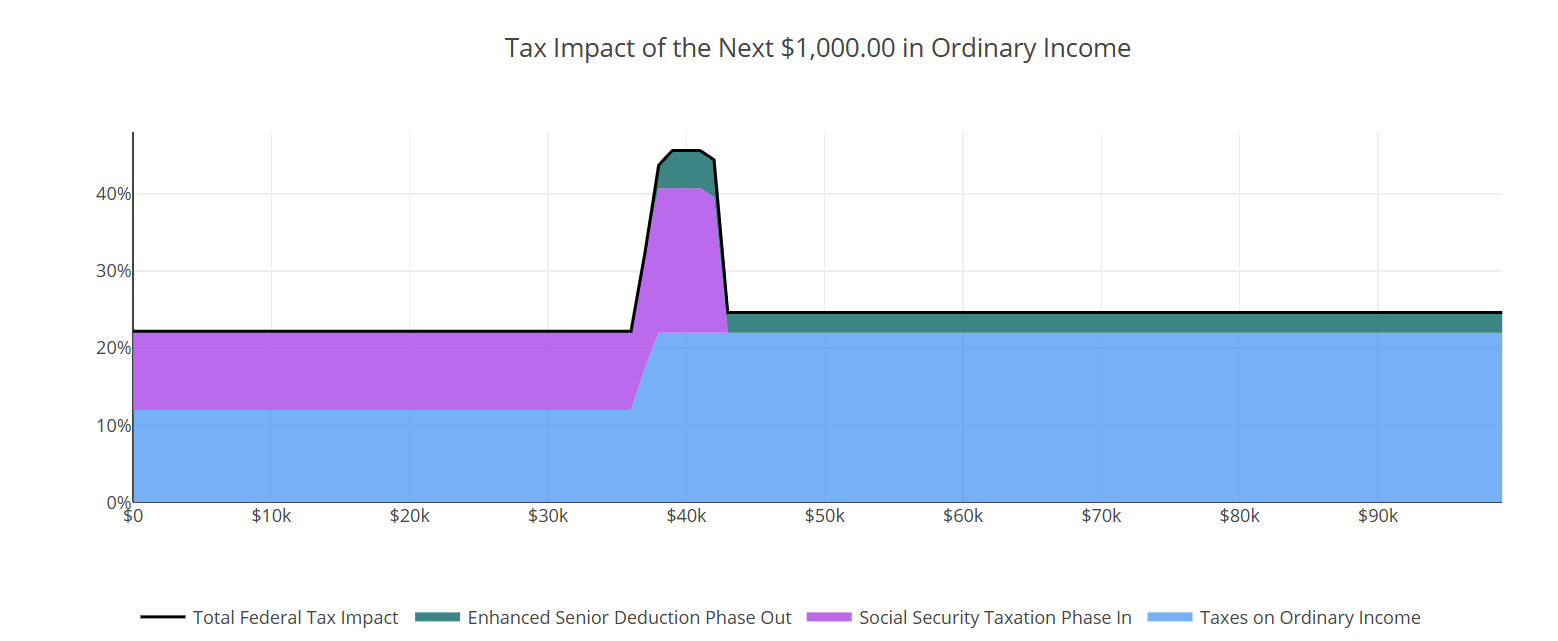
The chart above shows how additional income is estimated to affect a hypothetical married couple's total federal tax bill in 2026, assuming they are both age 65+ with a base case income scenario of $40,000 in Traditional IRA distributions and $90,000 of combined Social Security benefits.
If you were to only look at their taxable income at this starting baseline—which is $33,350 ($40,000 IRA + $40,850 taxable Social Security − $35,500 standard deduction − $12,000 enhanced senior deduction)—you might assume they have $67,450 of room left before hitting the top of the 12% bracket ($100,800).
However, the chart illustrates two critical considerations that are easy to miss:
- The top of the 12% bracket is really only ~$36,460 of additional gross income away ($67,450 / 1.85), because every dollar taken forces $1.85 of taxable income onto the return.
- Any additional IRA distributions taken up to that ~$36,460 mark will be taxed at an effective 22.2% rate. Once they cross into the 22% bracket, the combination of the 1.85 Social Security multiplier and the enhanced senior deduction phase-out causes their marginal tax rate on the next ~$10,000 of distributions to spike to over 45%.
To be clear, this tax impact alone shouldn’t necessarily stop you from withdrawing funds. If a distribution aligns with your retirement goals, covers a necessary expense, or funds something meaningful to you, it may be worth it. The goal is simply to be aware of the tax impact before you act, allowing you to be strategic about which account you draw from and preventing unpleasant surprises come tax time.
How Do I Pay the Taxes Owed on My Benefits?
Unlike a traditional W-2 paycheck, the Social Security Administration does not automatically withhold federal income taxes from your monthly check unless you tell them to. If you owe taxes on your benefits, you can either pay quarterly estimated taxes directly to the IRS or set up Voluntary Tax Withholding.
If you choose voluntary withholding, keep these three rules in mind:
- Fixed Percentages Only: You cannot instruct Social Security to withhold a custom dollar amount (e.g., "$150/month"). Under federal rules, you must select one of four fixed withholding tiers using IRS Form W-4V or your online my Social Security portal: 7%, 10%, 12%, or 22%.
- Calculated on Net, Taxed on Gross: Social Security calculates your elected tax withholding percentage on your Net Monthly Payment Amount—the benefit remaining after Medicare premiums (and IRMAA surcharges) are deducted. However, when you file your tax return, the IRS evaluates taxability on your Gross Benefit (before Medicare deductions).
- The Potential Withholding Gap: Because your chosen withholding percentage is applied to a smaller net check rather than your gross benefit, the total dollars sent to the IRS across the year will be slightly less than 7%, 10%, 12%, or 22% of your total gross income.
Because withholding is calculated on your net check after Medicare, verify with your tax professional that the total dollar amount withheld covers your projected tax liability.
The Planning Perspective
The Tax Torpedo is the classic example of why tax bracket planning and tax rate planning can be two different things. Looking strictly at standard tax brackets creates a false sense of security. Disarming this tax trap requires strategic tax diversification and multi-year income planning. Potential strategies may include executing Roth conversions during early retirement 'gap years' before claiming Social Security, or drawing strategically from taxable brokerage accounts to keep your taxable income below the phase-in threshold.
Ready to See How Social Security Fits Into Your Complete Retirement Plan?
Social Security claiming decisions shouldn't be made in a vacuum. How and when you claim can impact your lifetime income plan, portfolio drawdown strategy, multi-year tax planning, potential Roth conversion windows, and more.
Please Note: Sanders Retirement Planning is a comprehensive financial planning and investment management firm. We do not offer standalone Social Security filing services or single-topic phone consultations. We work with pre-retirees and retirees looking for a fully integrated, multi-year retirement income and wealth management strategy.
Important Disclosure: This guide is provided for informational and educational purposes only and does not constitute financial, tax, or legal advice. Every individual's situation is unique. Please consult your financial advisor, CPA, and/or estate attorney before implementing any strategy discussed here. All examples given are hypothetical in nature and are provided for illustrative purposes only, do not represent the actual results of any specific client, and are not guarantees of future investment performance or tax outcomes. Actual plan rules, employer matching structures, and individual tax profiles will vary.